
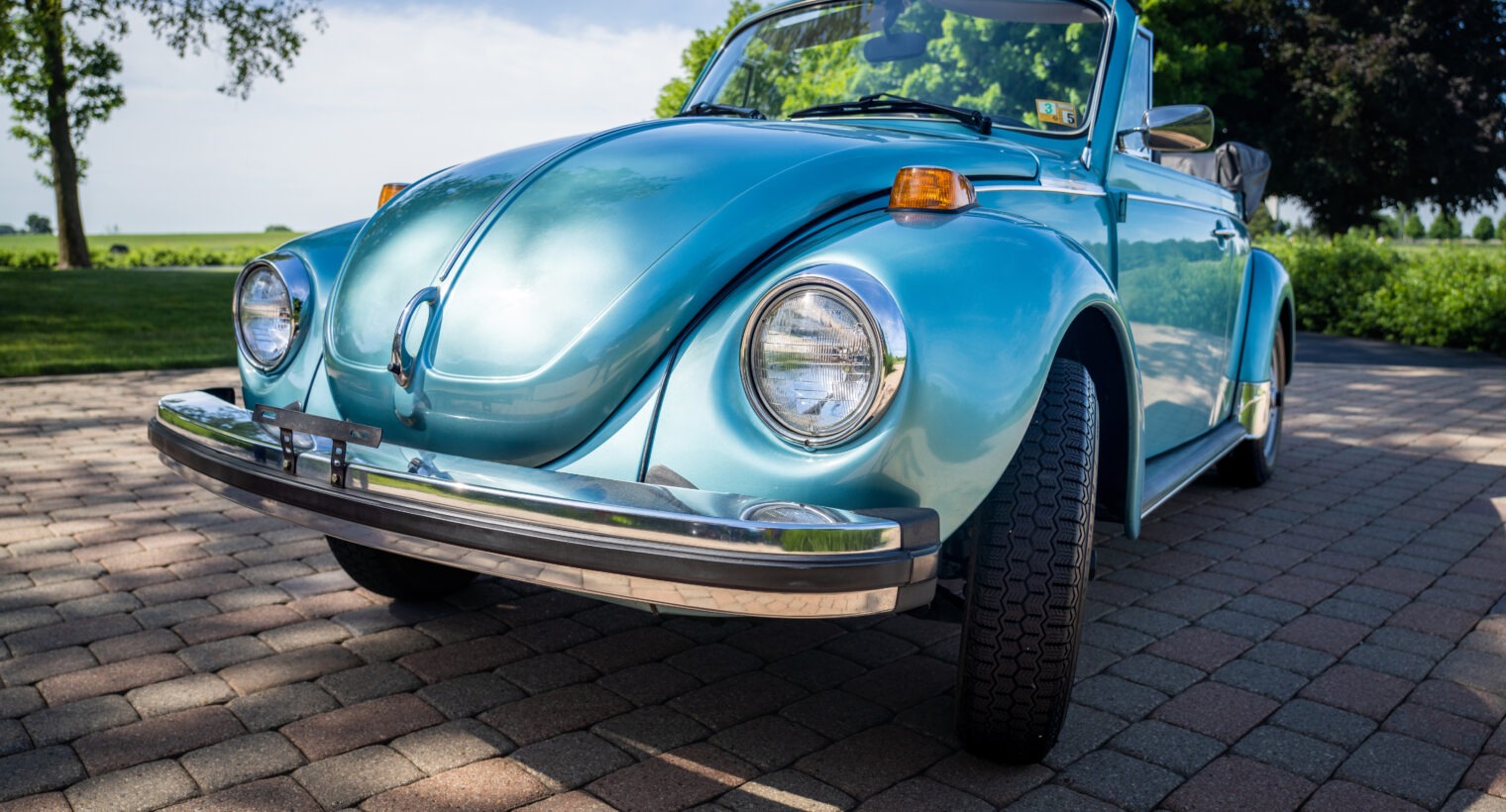
Origin: Wolfsburg, Germany
Engine: 4-Cylinder
Transmission: 4-Speed Manual
The Volkswagon Beetle is one of the most recognizable and iconic cars in the world, and arguably the best-selling car of all time, with over 21 million units sold.
“Volkswagen” means “The People’s Car.” It was designed to be as inexpensive as possible to produce, with an emphasis on ease, affordable repairs, and a low sticker price. Contrary to popular belief, the idea of such a vehicle was not dreamed up by Ferdinand Porsche and Adolf Hitler, but by Béla Barényi, a Hungarian inventor and engineer, in 1925. Porsche was the one to produce it though. After a few false starts, Beetles began rolling off the line in 1938. They weren’t called Beetles at the time though, but Kraftdurch-Freude-Wagen (“Strength Through Joy Car”) or KdF-Wagen for short. After 210 were produced, civilian production was halted due to WWII. The factory was later bombed and eventually captured by the Americans before being handed over to the British.
Production of the Volkswagen Beetle resumed thanks to British Army officer Major Ivan Hirst, who successfully disabled an unexploded bomb that had fallen through the roof of the factory and lodged itself between some pieces of irreplaceable production equipment. Seeing as the German people needed jobs and the British Army needed cars, Hirst convinced the British military to order 20,000 Volkswagens, dubbed Type 1s and nicknamed Käfer (“Beetle”).
Production transitioned back to civilian cars in 1947, and was given back to German control in 1949. In 1955, the millionth car rolled off the line. This 1961 Volkswagen Beetle Cabriolet is from the height of the Beetle’s popularity in North America, which would later decline in the 1970s due to stiff competition, new pollution control regulations, and an aging design.