
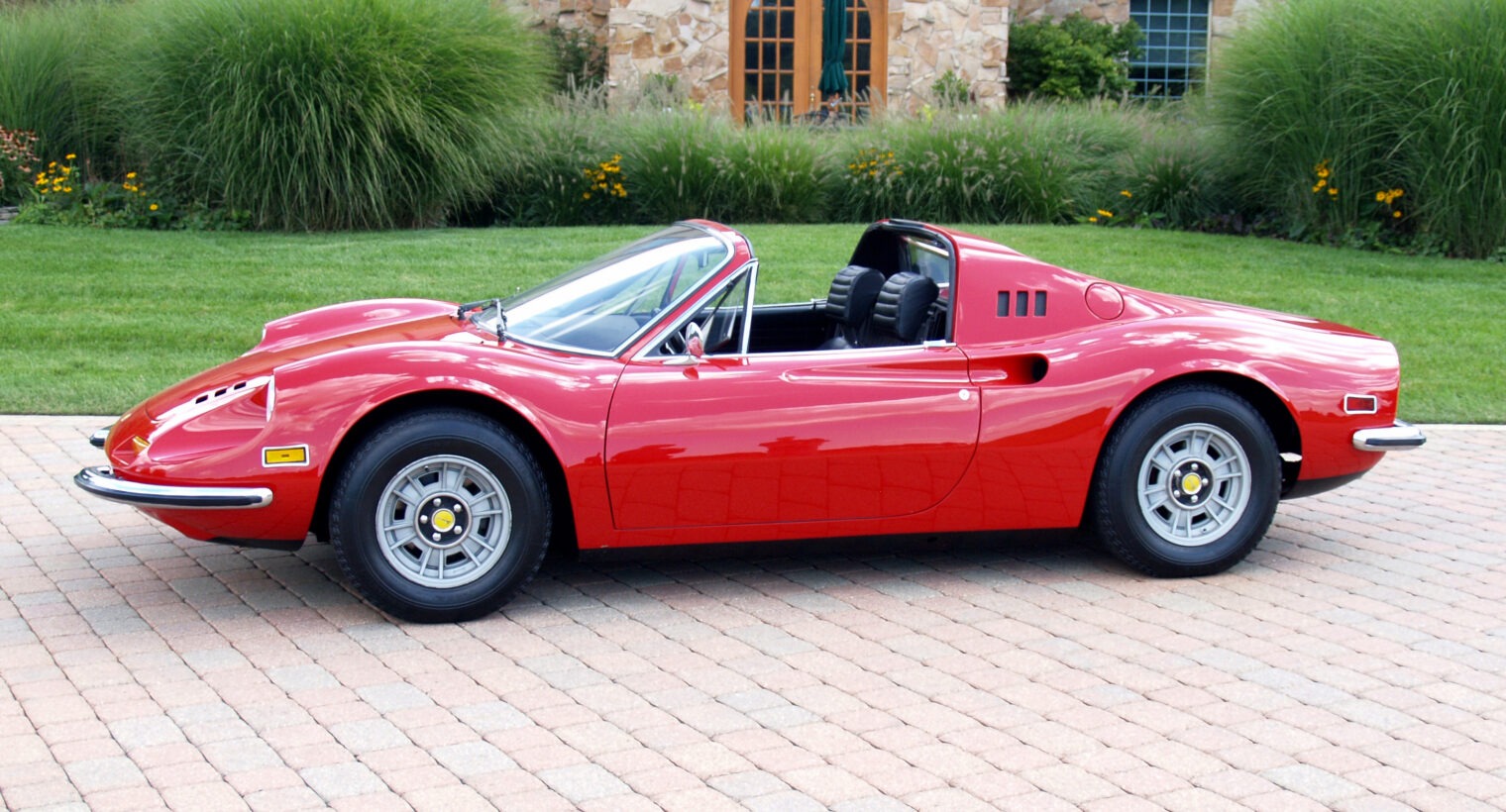
 Origin: Modena, Italy
Engine: 6-Cylinder
Transmission: 5-Speed Manual
The Ferrari Dino is a car all about legacy. Its story begins with Enzo Ferrari’s oldest son, Alfredo Ferrari, nicknamed Alfredino, or Dino for short. Dino convinced his father to produce a line of racing cars in the 1950s with V-6 and V-8 engines. To this end, Dino helped design a 1.5-litre V-6 engine that came to be known as the Ferrari Dino engine. Unfortunately, during this time, Dino was diagnosed with Duchenne muscular dystrophy. He passed away in 1956 at the young age of 24. He never got a chance to see his engine finished.
Ferrari honored his son as only an automaker could. He produced a car in Dino’s name, putting his son’s engine in it so his legacy could be realized. Every Dino has a badge and cylinder head covers that use Dino’s own signature. The first Dino was, of course, a race car—a 1957 Dino 156 F2 single seater intended for the Formula 2 series. The first road-going Dino was the 1967 Dino 206 GT, followed by the Dino 246.
The Dino 246 began production in 1969. It superseded the Dino 206 with a bigger engine, steel body, and longer wheelbase. It was only available as a fixed-top GT coupé until a targa topped GTS began being offered in 1971. This 1973 Ferrari Dino 246 GTS was one of the last. Only 1,274 were produced before the Dino 308/208 GT4 was introduced in 1973. Those were truly the last of the Dinos, as the branding changed back to Ferrari in 1976, followed by production ending in 1980.